Advocacy and Accountability Program
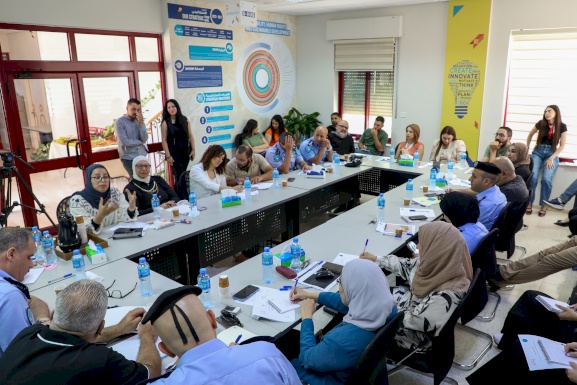
Advancing and Upholding the Rights of Persons with Disabilities
As part of its mission to advance disability inclusion in Palestinian society, QADER’s Advocacy and Accountability Program responds to the legal, political, and social challenges of the Palestinian context. The Program works to promote respect for, protect, and fulfill the rights of persons with disabilities. It seeks to influence policies, legislation, and practices, and to hold duty bearers accountable for meeting their national and international obligations.
The Program places particular emphasis on ensuring that the rights, priorities, and experiences of persons with disabilities are included in decision-making and accountability processes at the national, regional, and international levels.
The Program generates and uses evidence to support advocacy and accountability through research and analysis, policy and legislative review, and the monitoring and documentation of violations. It also tracks the implementation of international obligations and the concluding observations issued by human rights treaty bodies, conducts evidence-based advocacy campaigns, and engages with relevant United Nations mechanisms and international frameworks. In addition, the Program provides technical support to duty bearers to help them turn human rights commitments into policies, procedures, and practices that can be implemented and monitored.
Program Objectives
- Influence policies, legislation, and practices to bring them into closer alignment with international human rights standards, particularly the Convention on the Rights of Persons with Disabilities. This includes research and analysis, reviews of legal and policy frameworks, and practical policy papers, recommendations, and proposals for decision-makers and duty bearers.
- Strengthen follow-up on international obligations and concluding observations by developing a systematic mechanism to track progress on recommendations issued by international human rights treaty bodies, and by collecting, analyzing, and sharing evidence to support follow-up, accountability, and dialogue with duty bearers.
- Improve the monitoring and documentation of human rights violations through a disability-inclusive lens, using relevant United Nations methodologies and international standards. This work includes the experiences of persons with disabilities in evidence gathering, analyzes violations under international human rights law, international humanitarian law, and international criminal law, and uses the findings to support advocacy, accountability, and effective remedies.
- Develop and carry out evidence-based advocacy campaigns at the national, regional, and international levels. Drawing on research, monitoring, documentation, and the experiences of persons with disabilities, these campaigns seek to influence relevant policies, practices, and agendas, and mobilize support for disability rights priorities.
- Advance national and international accountability through active engagement with United Nations treaty bodies, other UN mechanisms, and relevant international frameworks. The Program prepares and submits human rights reports, contributions, and documented information; monitors duty bearers’ compliance with their obligations; and advocates for accountability and effective remedies for violations affecting persons with disabilities.
- Provide technical support to duty bearers and public authorities to strengthen their ability to meet their responsibilities toward persons with disabilities. This includes technical advice, the review and development of policies, procedures, and tools, and capacity building.
- Promote the meaningful participation of persons with disabilities in advocacy and accountability. Particular attention is given to women, girls, children, and young people with disabilities, as well as people facing multiple and intersecting forms of discrimination. The Program supports them to share their experiences and priorities directly, engage with decision-makers and accountability mechanisms, and help shape the messages, demands, and recommendations concerning their rights.
Our Approach
The Program takes a human rights-based, participatory, and evidence-based approach. It connects research, monitoring, and documentation with advocacy, policy influence, and accountability. Research, policy papers, reports, and monitoring are used to identify gaps and responsibilities, develop recommendations and demands, and guide advocacy and dialogue with duty bearers.
The Program systematically tracks progress in implementing human rights obligations and the concluding observations of international human rights treaty bodies. It organizes, analyzes, and makes relevant evidence and data available for follow-up and accountability.
It also monitors and documents violations affecting persons with disabilities in line with relevant international standards and methodologies. This work takes a disability-inclusive approach that supports accessibility, safe and meaningful participation, and recognition of the diversity of people’s experiences. The resulting evidence informs legal analysis, advocacy, and national and international accountability processes.
Building on this evidence, the Program carries out advocacy campaigns and initiatives at the national, regional, and international levels. It engages decision-makers, duty bearers, and other influential actors through dialogue, policy papers, reports, human rights messages, international mechanisms, alliances, and networks.
Alongside its monitoring and accountability work, the Program engages constructively with duty bearers and provides technical support. This helps them understand their obligations, identify gaps, and develop the policies, procedures, tools, and plans needed to address them. The Program combines calls for accountability with support for compliance while maintaining the independence of its monitoring and advocacy work.
The direct participation of rights holders guides all these efforts. Persons with disabilities are active partners and leaders in producing evidence, setting priorities, shaping messages and recommendations, leading advocacy and dialogue with duty bearers, and participating directly in national and international accountability mechanisms.