QADER at the Regional Seminar: Child Protection in Conflict Cannot Be Achieved Without Inclusion and Effective Accountability
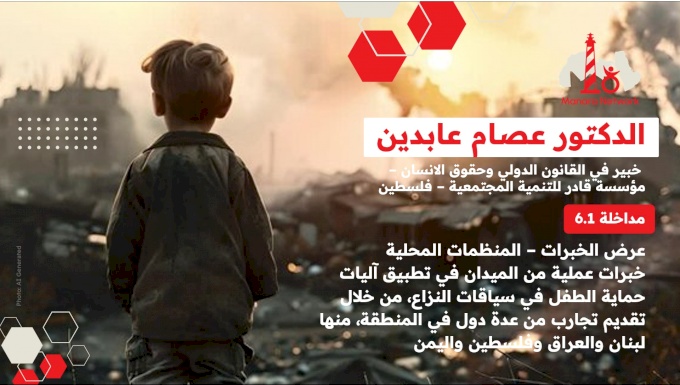
QADER for Community Development participated in the regional seminar on child protection in armed conflict, titled “From Legal Frameworks to Practical Implementation,” at a critical regional moment marked by escalating grave violations against children and a widening gap between international legal standards and their enforcement on the ground, particularly in Palestine. This comes amid the ongoing genocide and other international crimes in the Gaza Strip and across the occupied Palestinian territory, and the compounded catastrophic impact these violations have on children, especially children with disabilities.
QADER affirmed that what children are experiencing in conflict settings can no longer be characterized as collateral effects of armed conflict; rather, it constitutes a systematic, direct, and large-scale pattern of targeting. The Palestinian context stands as the clearest example, as underscored by the United Nations, which has identified the Gaza Strip as the most dangerous place in the world for children. This is evidenced by the deliberate killing of approximately 20,000 children, leaving thousands more with disabilities, in addition to policies of starvation, persecution, forcible transfer, apartheid, and deprivation of basic services, among other violations perpetrated by the colonial occupation. These violations have compounded impacts on children, particularly children with disabilities, thereby necessitating strengthened protection systems and the activation of accountability and redress mechanisms.
QADER emphasized that the international legal framework, despite its clarity and advancement, faces a genuine crisis at the enforcement stage. Evidence continues to accumulate and reports multiply, while accountability pathways falter, justice is delayed, and children and their families are left to confront devastating long-term consequences. This reflects a profound failure in political will among United Nations Member States, as well as shortcomings in implementation, oversight, and accountability mechanisms.
QADER further highlighted in its keynote intervention that the transition from documentation to accountability remains the weakest link in the protection system, despite ongoing efforts. This underscores the need to strengthen documentation tools to ensure the quality of evidence and its admissibility in judicial processes, as well as to enhance linkages between the work of civil society organizations and national and international judicial mechanisms, in order to achieve substantive - rather than merely formal - accountability.
QADER stressed that a disability inclusion approach must be an integral component of any legal or humanitarian response. Children with disabilities face compounded risks in armed conflict, not only in terms of exposure to grave violations, but also through exclusion from rights and basic necessities, protection and relief services, the absence of disaggregated data, and the failure to ensure that interventions are accessible to their needs. This stands in clear contradiction to international obligations, foremost among them the Convention on the Rights of Persons with Disabilities (CRPD).
QADER affirmed that the psychosocial impact of armed conflict on children is no less severe than physical violations; rather, it extends to create deep and long-term scars, including trauma-related disorders, loss of safety, and the deterioration of health conditions, educational opportunities, and a dignified life. These impacts are compounded for children with disabilities, who face multiple and intersecting barriers in accessing support and care services. QADER further underscored the need to reframe the United Nations’ approach by embedding disability inclusion within humanitarian response, protection, and accountability frameworks.
Building on this, QADER for Community Development affirms that the protection of children in armed conflict cannot be achieved through legal provisions alone. It requires genuine political will from States and the United Nations system, effective and enforceable accountability mechanisms, and an integrated approach that bridges law, policy, and field-level practice. Such an approach is essential to translate legal obligations into tangible and effective protection on the ground, and to close the deep gap between legal recognition and the lived exposure of children in armed conflict.
QADER presented its recommendations at the conclusion of its intervention in the regional seminar, emphasizing the following:
1. Activating international accountability mechanisms, including effective cooperation with international commissions of inquiry and the International Criminal Court (ICC), as well as the activation of universal jurisdiction, to ensure the prosecution of perpetrators of violations and international crimes against children and to prevent impunity.
2. Strengthening the role of United Nations mechanisms, in partnership with civil society organizations, in evidence-based documentation, the chain of custody, and the use of modern technologies, while ensuring a disability inclusion approach, and guaranteeing that reports are translated into effective advocacy tools that advance accountability.
3. Strengthening monitoring and documentation systems to ensure the quality of evidence and its admissibility for judicial use, enhancing institutional linkages between documentation and judicial pathways, and adopting disability inclusion as a core analytical lens for understanding and documenting violations targeting children in field settings.
4. Institutionalizing cooperation between civil society organizations and official entities to ensure complementarity of efforts and maximize impact in the protection of children, particularly children with disabilities, across specialized assessments, databases, documentation, analysis, and accountability pathways.
5. Adopting a disability inclusion approach as a binding, cross-sectoral framework across all phases of the response, including monitoring and documentation, relief, rehabilitation, and accountability, by ensuring accessibility, providing reasonable accommodations, and developing tools and programs that address the diversity of disabilities, thereby ensuring that children with disabilities are not excluded and are included on an equal basis in all types of interventions.
6. Integrating psychosocial support as a core component of the humanitarian response, while developing specialized programs to address the long-term impacts of conflict on children and ensuring particular attention to children with disabilities within psychosocial support interventions, given the compounded effects they experience. This includes guaranteeing their access to appropriate and safe services, strengthening reasonable accommodations and accessibility, and embedding a disability inclusion approach throughout.
7. Supporting families and caregivers as part of the recovery framework and strengthening their capacity to respond to the impacts of armed conflict and grave violations on children, including the compounded and intersecting effects on children with disabilities across different disability types, while enhancing protection and access to justice.
8. Aligning national legislation and policies with international standards, including the Convention on the Rights of the Child (CRC) and its Optional Protocols, and the Convention on the Rights of Persons with Disabilities (CRPD), in a manner that always ensures effective and comprehensive protection for children, particularly in situations of armed conflict and colonial occupation.
9. Emphasizing the need to establish a “Regional Observatory for the Protection of Children in Armed Conflict,” in partnership with the United Nations system, as a regional platform to strengthen protection and collective action, ensuring the availability of disaggregated data, advanced documentation tools, and pathways for accountability and redress.
QADER affirms that its participation at the regional level does not constitute a concluding milestone, but rather a starting point toward more rigorous and effective institutional action, grounded in translating legal commitments into tangible reality and ensuring that the protection of children remains a priority that is not subject to double standards. History does not only record those who commit crimes; it also records those who had the power to stop them and chose not to.