

Strategic Position Paper: Rebuilding the UN’s Approach to Disability Inclusion in Palestine after the Genocide
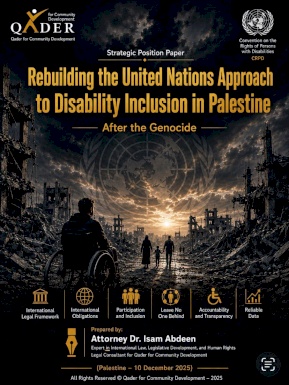

This paper is issued at an unprecedented historical moment for persons with disabilities in Palestine, particularly in the Gaza Strip, where genocide, policies of starvation, forced transfer, and an apartheid regime intersect with the near-total collapse of protection systems and essential services. In this context, the ability of the United Nations system to rebuild a disability-inclusive approach constitutes a genuine test of its commitment to the reference frameworks of international law, foremost among them the Convention on the Rights of Persons with Disabilities (CRPD), the United Nations Disability Inclusion Strategy (UNDIS), the Advisory Opinion of the International Court of Justice (ICJ) issued on 19 July 2024, and the General Assembly resolution adopted on 18 September 2024 concerning the illegality of the occupation and the resulting responsibilities of all States and United Nations bodies and agencies.
The annual consultative meeting between the United Nations Resident Coordinator, the United Nations Country Team, and organizations of persons with disabilities represents one of these core tests. It should not be reduced to a procedural event, but rather understood as a legal obligation arising from the duties of the United Nations system under the Convention on the Rights of Persons with Disabilities (CRPD), the United Nations Disability Inclusion Strategy (UNDIS), Security Council resolution 2475 (2019) on the protection of persons with disabilities in armed conflict, and the 2024 Advisory Opinion of the International Court of Justice and the related General Assembly resolution, which affirm the illegality of the occupation and impose specific obligations on all States and on United Nations bodies and agencies.
A critical reading of the concept note for the consultative session reveals a “minimum-standard” approach: a softened language regarding the crimes of genocide in Gaza; a reduction of structural collapse into mere operational “challenges”; the omission of the international legal framework most relevant to the Palestinian context; and the presentation of the annual meeting as the fulfillment of a procedural requirement in the “Inclusion Indicator” rather than as a pathway toward institutionalizing partnership and accountability. The Situation Analysis of Disability (SITAN) report—despite its importance—also appears as an underutilized tool whose findings were neither translated into commitments nor operationalized into action plans. Moreover, the impact of the genocide on data was disregarded, as the report relied on the 2017 population census in a context that has undergone profound transformation due to the large-scale destruction in Gaza.
In light of this, the present analytical paper outlines four structural priorities that no UN approach can overlook;
- Institutionalizing disability inclusion within the United Nations system and linking it to decision-making levels;
- Investing in the institutional capacities of organizations of persons with disabilities as structural partners rather than “beneficiaries”;
- Rebuilding the data system using internationally recognized methodological tools that respond to the new and escalating disabilities resulting from the crimes of genocide and other international crimes for more than two years, as documented by United Nations experts and international judicial bodies;
- Embedding disability at the core of the design of recovery and reconstruction plans, rather than treating it as a secondary element or an operational annex.
Building on this analysis, the paper presents a set of practical recommendations for the Resident Coordinator and the UN Country Team. These include: positioning disability as a structural pillar in recovery planning; institutionalizing UN leadership on disability inclusion and linking it with the Cluster system; allocating multi-year funding to organizations of persons with disabilities (OPDs); establishing a joint national–UN data system; aligning humanitarian pathways with the Convention on the Rights of Persons with Disabilities (CRPD); creating a multi-level monitoring and accountability mechanism, with transparent quarterly reporting; and integrating the legal dimension of genocide into UN planning.
This analytical paper does not offer a procedural critique; rather, it calls for a fundamental reframing of the UN’s approach to disability in Palestine. The future of disability inclusion hinges on leadership, institutionalization, and accountability. Without these, the annual “consultative” meeting will remain a formalistic milestone, and disability inclusion will continue to be marginalized amid an escalating catastrophe. However, if the paper’s proposals are adopted as a strategic pathway, the UN system can shift from rhetorical commitment to actual response, and build a new approach grounded in dignity, justice, and inclusion - one that ensures persons with disabilities are not left behind again.